Client Layout Approval: Show the Countertop Before You Cut It
Your client sees the exact layout on the exact slab. They approve or request changes. Then you cut what was approved.
SlabKast gives fabricators a digital approval workflow that shows homeowners, designers, and contractors exactly what the countertop will look like — on the actual stone — before the first cut is made. No more “that's not what I expected.”
The trust gap between fabricator and client
Fabricators know the result will look good. They have cut hundreds of kitchens. They understand slab geometry, vein direction, and seam placement. They know that the layout they have planned will produce a beautiful countertop because they have the training and experience to visualize the finished product from a raw slab and a stack of templates.
Clients have to imagine it. They chose a slab at the stone yard based on the overall look of the full slab surface. They have no idea which part of that slab will become their island, which part will be their perimeter run, or how the veins will align at the seams. They are spending $5,000 to $25,000 on a product they cannot preview. They trust the fabricator to make it look right.
That gap between the fabricator's knowledge and the client's imagination is where $4,000 remakes happen. The fabricator delivers a countertop that is structurally perfect and aesthetically sound by professional standards. The client says “that's not what I expected” because what they imagined was different from what was produced. Both sides lose.
The fabricator loses material, labor, and schedule time on a remake. The client loses trust and confidence. The relationship between fabricator, contractor, and homeowner is strained. In worst cases, the dispute becomes adversarial — reviews, chargebacks, or legal threats over a product that was objectively well-made but subjectively disappointing.
This is not a craftsmanship problem. It is a communication problem. The fabricator made the right decisions but could not show the client what those decisions looked like before cutting. The client approved the slab material but never approved the specific layout, specific seam positions, or specific vein alignment on their countertop.
Digital layout approval closes this gap. The client sees exactly what they will get. They approve exactly what they will get. The gap between imagination and reality disappears because the client no longer has to imagine anything. They see it.
How digital layout approval works
The approval process takes minutes to set up and eliminates the most expensive category of disputes in stone fabrication.
Create the layout on the real slab
Photograph the slab and calibrate it in SlabKast. Import your DXF templates or draw pieces directly. Position each piece on the slab image, optimizing for vein alignment, seam placement, and material yield. This is the same layout process you would do for fabrication planning — the approval workflow adds sharing, not extra work.
Generate a shareable approval link
Once you are satisfied with the layout, generate a shareable link. Send it to the client via email, text message, or any communication channel you use. The link works on any device — phone, tablet, or computer. No app installation, no account creation, no downloads. The client clicks and sees.
Client reviews and responds
The client opens the link and sees their template pieces positioned on their specific slab. Veins visible. Seams visible. They see what their countertop will look like, made from this specific stone. They approve the layout, or they say “can you move the seam?” or “try rotating that piece.” Changes cost nothing at this stage — you are adjusting digital pieces, not re-cutting stone.
Approval documented, fabrication begins
When the client approves, the approval is timestamped and stored with the project. You now have a documented record of exactly what was approved. You cut what the client signed off on. If there is ever a dispute post-installation, you have visual proof that the delivered countertop matches the approved layout. This protects your shop from claims that are otherwise impossible to defend.
What the client sees
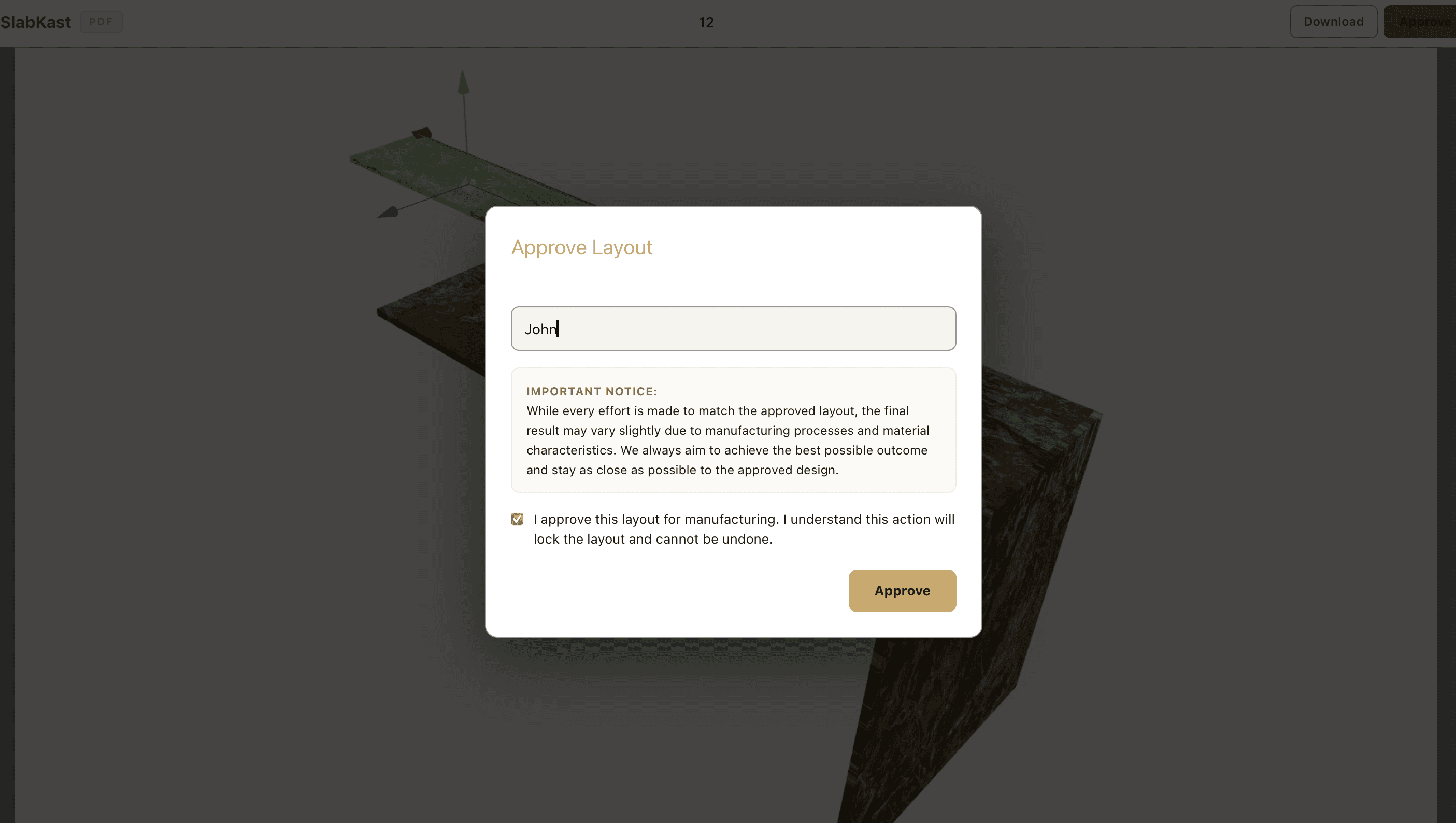
The approval view shows the real slab photo with piece outlines positioned on it. This is not a render. Not a generic mockup. Not a sample image from a manufacturer's website. It is the actual photograph of the actual slab that the client selected, with the actual template pieces positioned where they will be cut.
The vein pattern is visible through each piece outline. The client can see how the veins flow across their island, how the vein direction runs along their perimeter countertop, and how the pattern transitions at each seam. Seam locations are clearly visible where pieces meet. The client sees the stone, the layout, and the seams — the three elements that determine how the finished countertop will look.
This level of visual specificity is what separates digital approval from traditional “approval.” When a client approves a slab selection at the stone yard, they approve the material. When they approve the layout in SlabKast, they approve the design. They see the specific piece of each slab area that becomes each piece of their countertop.
The approval view includes:
- +The real slab photograph with accurate color and vein representation
- +Template piece outlines showing the exact cut positions on the slab
- +Vein flow visible through each piece, showing how the stone will look installed
- +Seam locations clearly marked where pieces meet
- +Piece labels identifying which template piece maps to which area of the countertop
- +The ability to view on any device without software installation
The approval record protects your shop
Every fabricator has heard it: “That's not what I agreed to.” After installation, the client claims the seam is in the wrong place, the veins are going the wrong direction, or the piece was cut from the wrong part of the slab. Without documentation, it is the fabricator's word against the client's. The fabricator usually absorbs the cost to preserve the relationship.
With SlabKast, the approval is documented. The system records what was presented (the exact layout on the exact slab), when it was presented, and when it was approved. If there is ever a dispute, you can show that the delivered countertop matches the layout the client approved. This is not about being adversarial with clients. It is about having a shared reference that prevents misunderstandings from escalating into disputes.
The approval record also protects the fabricator in multi-stakeholder projects. When the homeowner approves but the designer disagrees after installation, the approval record shows who approved what and when. When the general contractor claims the layout was supposed to be different, the approval record provides the definitive answer.
Consider the financial exposure. Without documented approval, a client complaint about seam placement or vein direction can cost $2,000 to $5,000 in remakes even when the fabricator did nothing wrong. A single bad review from an angry client can cost $10,000 or more in lost future business. The approval record eliminates both risks by establishing a documented agreement before fabrication begins.
Shops that implement digital approval report that disputes decrease dramatically. Not because the work quality changed, but because the expectations changed. When clients see and approve the specific layout before cutting, the post-installation surprise factor disappears. They got exactly what they approved. And both parties know it.
The approval record is not just about dispute prevention. It is about professional process. The best shops in the industry already have some form of client sign-off. Digital approval makes that sign-off visual, specific, and documented rather than verbal, vague, and forgettable.
Approval changes the sales conversation
Digital layout approval is not just protection. It is a sales tool. Shops report that showing clients the layout on the real slab changes the buying conversation in measurable ways.
Clients upgrade materials when they can see the result. A homeowner considering Level 1 granite at $45 per square foot is hesitant to spend $120 per square foot on Calacatta marble because they cannot visualize how it will look in their kitchen. Show them the actual layout on the actual Calacatta slab — the bold veins flowing across their island, the dramatic waterfall edge — and the upgrade sells itself. The uncertainty that held them back was not about budget. It was about risk. Digital preview eliminates that risk.
Shops also report higher close rates overall. When a potential client visits two fabrication shops and one shows them a digital preview of their countertop on the actual slab while the other says “trust us, it will look great,” the choice is straightforward. The shop that provides visual confidence wins the job.
The sales advantage extends beyond the homeowner. Interior designers and architects specify stone for their clients. When a fabrication shop offers digital layout approval, the designer can show their client exactly what the countertop will look like before committing. This makes the designer's job easier, and designers refer future work to shops that make their job easier.
General contractors value the approval workflow for a different reason: risk management. A documented client approval on the countertop layout reduces the contractor's exposure to change orders and disputes. Contractors who work with shops offering digital approval know that the countertop phase will not produce the “that's not what I wanted” moment that delays the entire project.
Digital approval is a competitive differentiator. In a market where most fabrication shops offer similar materials, similar pricing, and similar craftsmanship, the ability to show the client exactly what they will get is the factor that wins bids and commands premium pricing.
Works for every stakeholder
Anyone who needs to sign off before cutting can view and approve the layout. No software installation, no account creation, no learning curve.
Homeowners
The homeowner selected the slab because they loved how it looked. The approval view shows them exactly which part of that slab becomes their countertop. They see the veins they fell in love with positioned on their specific kitchen layout. This visual confirmation converts nervousness into excitement and prevents the post-installation disappointment that leads to disputes.
Interior designers
Designers specify stone based on the overall aesthetic of the space. They need to see how the specific slab layout coordinates with the cabinetry, flooring, and color palette they have specified. The approval view gives designers the visual confirmation they need to sign off on the stone fabrication without a site visit to the shop. Share the link, get feedback, finalize remotely.
Architects
On commercial and high-end residential projects, the architect may need to approve stone layouts for lobbies, reception desks, feature walls, and bathroom vanities. The approval view provides the visual documentation that architects require for their project files. It also ensures that the fabricated result matches the design intent specified in the architectural drawings.
General contractors
GCs coordinate all trades on a project. They need to know that the countertop will not cause a dispute that delays the schedule. A documented layout approval from the homeowner (and designer, if applicable) gives the GC confidence that the stone phase will proceed without callbacks. The approval link is easy to forward and archive in the project record.
Property managers
Multi-unit residential and commercial projects require approvals from property management teams who may be remote. The shareable approval link lets property managers review and approve countertop layouts without visiting the fabrication shop. They see the layout, confirm it meets the project specifications, and approve from their office.
The fabrication team
The approval workflow benefits the fabrication team too. When the CNC operator or saw operator receives a layout that has been client-approved, they cut with confidence. No second-guessing whether the seam position is correct. No calls to the office asking “did the client see this layout?” The approved layout is the layout. Cut it.
Common questions about client layout approval
How does the client layout approval process work?
After you create the layout in SlabKast by positioning template pieces on the calibrated slab photo, you generate a shareable approval link. Send that link to the client via email, text, or any messaging platform. The client opens the link on their phone or computer and sees the exact layout on the exact slab — piece positions, seam locations, and vein flow all visible. They can approve the layout or request changes. The approval is timestamped and stored in your project record.
What does the client see in the approval view?
The client sees a visual representation of their countertop layout on the actual slab photograph. Template piece outlines show where each piece will be cut. The real stone texture — veins, color variation, surface character — is visible under each piece. Seam locations are clearly marked where pieces meet. The client sees the actual stone they selected, not a generic sample or a digital render. This is the stone that will be in their kitchen.
Can the client request changes to the layout?
Yes. The approval process is collaborative, not one-way. If the client wants the seam moved, a piece rotated to change vein direction, or a different area of the slab used, they can communicate those preferences. You make the adjustments in SlabKast and send an updated approval link. Changes at this stage cost nothing — you are moving digital pieces on a digital slab. This iterative process continues until both parties agree on the final layout.
Is the approval legally binding?
The SlabKast approval record is a documented timestamp showing what was presented and when it was approved. Whether it constitutes a legally binding agreement depends on your jurisdiction and your specific contract terms. Many fabrication shops include a clause in their contract referencing the SlabKast approval as the agreed-upon layout specification. Consult your legal advisor about incorporating digital approvals into your contract workflow.
Does the client need to install anything to view the layout?
No. The approval link opens in any standard web browser on any device — phone, tablet, or computer. The client does not need to create an account, install an app, or download any software. They click the link, see the layout, and approve or provide feedback. This zero-friction approach means even the least tech-savvy clients can participate in the approval process.
Can I share the layout with multiple stakeholders?
Yes. The approval link can be shared with anyone who needs to review the layout — the homeowner, interior designer, architect, general contractor, or property manager. Each stakeholder sees the same layout on the same slab. This eliminates the telephone-game effect where different parties have different understandings of what the countertop will look like. Everyone sees the same thing, and everyone can provide feedback before fabrication begins.
Give your clients visual confidence. Try free.
Start your 7-day free trial. Create a layout, share it with your client, and get documented approval before you cut. No credit card required.
Need seam planning and vein matching too? Explore slab layout software →