Vein Matching Software for Stone Fabricators
See how veins align across seams, around waterfall edges, and between bookmatched pieces — before you make a single cut. SlabKast vein matching software lets you digitally rotate, flip, and position template pieces on a calibrated slab photograph so you can preview exactly how the stone grain will flow across the finished installation.
No scanner. No guesswork. No $3,000 remakes when veins clash at the seam line. Start matching veins digitally for $149/month.
Vein mismatches cause $3,000 to $4,000 remakes
Natural stone is sold on its beauty. A customer chooses Calacatta marble for its dramatic veining, Taj Mahal quartzite for its flowing gold patterns, or Fantasy Brown granite for its distinctive movement. When those veins do not align at the seam — when a bold diagonal vein on one piece meets a horizontal pattern on the adjacent piece — the entire installation looks like a mistake.
The problem is that most fabrication shops have no way to preview vein alignment before cutting. The traditional process works like this: a fabricator holds a paper template against the slab, marks the cut lines with a wax pencil, eyeballs the vein direction, and hopes for the best. On solid-color granite, this works well enough. On heavily veined marble or quartzite — the materials that command the highest prices and the pickiest customers — it is a gamble.
When the gamble fails, the cost is severe. A single vein-mismatched kitchen countertop remake costs $3,000 to $4,000 in wasted material, re-fabrication labor, and schedule disruption. For exotic materials like bookmatched Patagonia quartzite or Calacatta Viola marble, the remake cost can exceed $8,000 because the replacement slab alone costs thousands of dollars.
The financial impact compounds beyond direct remake costs. A visible vein mismatch that the customer discovers after installation leads to disputes, negative reviews, and lost referrals. In an industry where most shops depend on word-of-mouth and contractor relationships, a single botched vein match can cost far more in future business than the immediate remake expense.
Scanner systems like Slabsmith solve this problem for shops willing to invest $15,000 to $60,000 in hardware and software. But for the majority of fabrication shops, the cost of a scanner cannot be justified. These shops handle the most vein-critical work without any digital visualization tools at all.
This is not a niche problem. Industry data suggests that vein-related remakes account for a significant portion of all fabrication redo work, and the rate increases as customers increasingly choose bold, heavily veined materials influenced by design trends on social media and home renovation shows. The demand for flawless vein matching is growing, but most shops' ability to deliver it has not changed in twenty years.
How digital vein matching works in SlabKast
SlabKast turns vein matching from an experienced-fabricator-only skill into a visual, repeatable process that any team member can perform.
Photograph and calibrate the slab
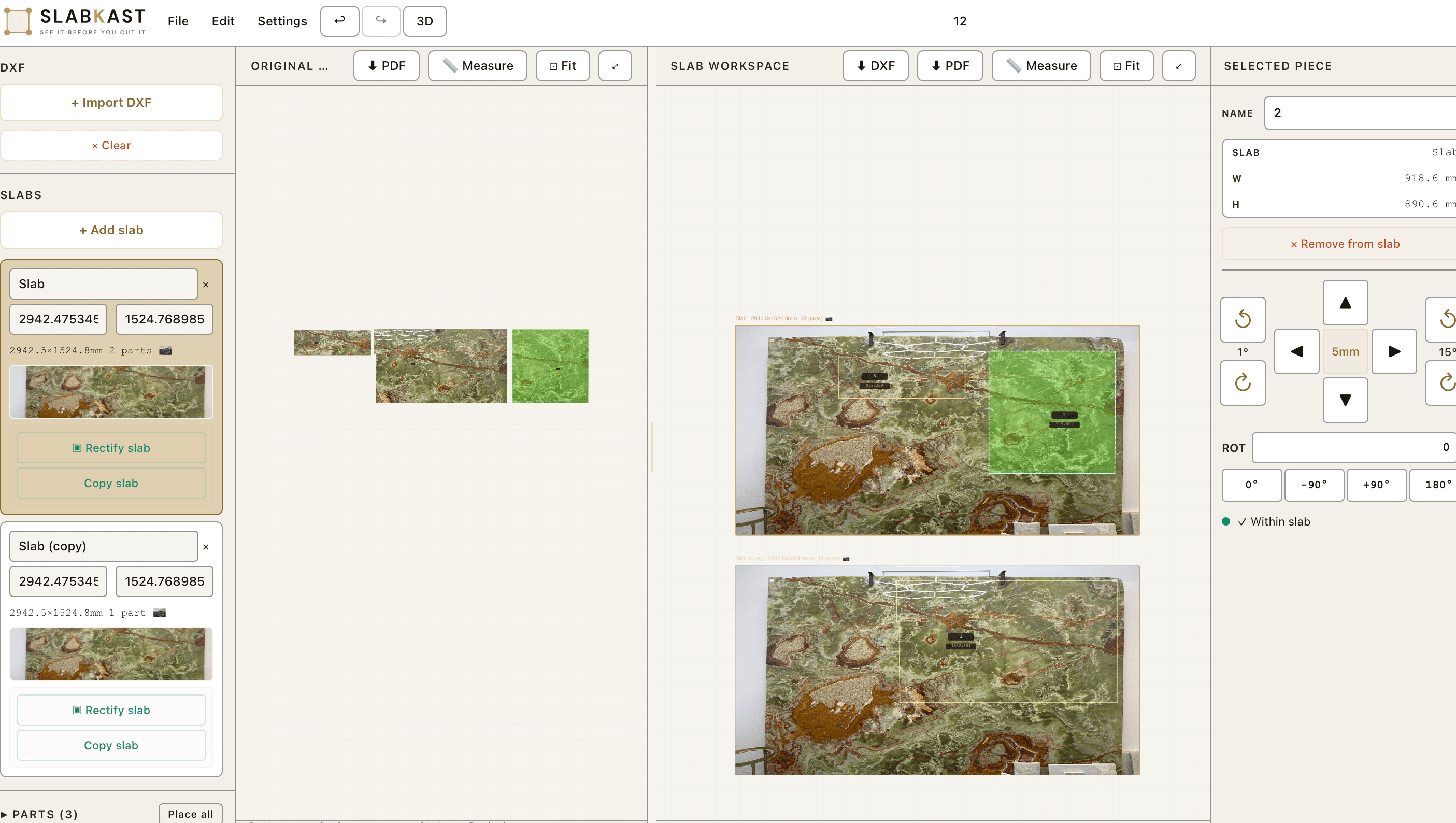
Take a photo of the slab with any smartphone. In SlabKast, mark the four corners and enter the slab dimensions. The software applies perspective-correct rectification, creating a dimensionally accurate digital image where every pixel maps to a real-world measurement. The slab's actual vein pattern, color variation, and surface character are all preserved in the calibrated image. This is your digital twin of the physical slab.
Place template pieces on the slab
Import DXF templates from your laser templater or draw pieces directly in SlabKast. Drag each piece onto the calibrated slab image. As you position a piece, you see the actual stone texture under it — the real veins, the real color, the real movement. This is the key advantage over paper templates: you are not guessing what the stone will look like under each piece, you are seeing it.
Rotate and flip pieces to align veins
This is where the magic happens. Select any piece and rotate it to find the vein angle that best matches the adjacent piece at the seam line. Flip pieces to create mirror-image vein patterns for bookmatching. Slide pieces millimeter by millimeter along the slab to find the position where the vein crosses the seam most naturally. You can try dozens of positions in seconds — something that would take hours with physical templates on a real slab.
Preview the finished result
Once you have the vein alignment you want, preview the layout as it will appear installed. See the seam lines with the vein flowing across them. Check waterfall edge continuity. Verify that the bookmatched island panels create the symmetry the designer specified. Send the preview to your client for approval so they see and sign off on the vein alignment before you cut a single piece.
Where vein matching matters most
Every project with veined stone benefits from digital vein matching, but these applications are where it prevents the most expensive mistakes.
Bookmatching
Bookmatching creates a mirror-image pattern by placing two sequential slab cuts side by side, like opening a book. The effect is dramatic — symmetrical vein patterns that create a butterfly or cathedral pattern across a countertop or wall. But bookmatching only works when the pieces are positioned precisely. A few centimeters of misalignment at the center seam destroys the symmetry. SlabKast lets you digitally flip and position bookmatched pieces until the mirror line is perfect, then lock the layout for CNC export.
Waterfall edges
A waterfall edge is where the stone continues vertically down the side of an island or peninsula, creating a continuous flow of material from the horizontal surface to the floor. The vein pattern must flow uninterrupted from the countertop surface over the edge and down the panel. If the vein direction shifts at the miter joint, the waterfall effect fails. SlabKast shows you exactly how the vein will transition from the horizontal piece to the vertical panel so you can adjust placement before cutting.
Island continuity
Large kitchen islands often require two or three pieces joined at seams. The customer expects the vein pattern to flow continuously across the entire island surface as if it were a single piece of stone. Without vein matching software, achieving this requires an experienced fabricator to physically position templates on the slab and make judgment calls about vein direction. With SlabKast, any team member can digitally arrange the island pieces until the vein flow across seams is seamless, then share the result with the client for approval.
Backsplash matching
When a full-height stone backsplash meets the countertop, the vein pattern should coordinate between the two surfaces. Customers notice when the backsplash veins run in a completely different direction than the countertop veins. SlabKast lets you plan the backsplash cut from the same slab as the countertop, positioning both pieces to ensure the vein direction is complementary. You can also plan backsplash pieces from remnant areas of the slab to maximize material usage while maintaining vein coordination.
What changes with vein matching software
Without vein matching software
- --Fabricator eyeballs vein direction with paper templates on the physical slab
- --Only the most experienced team members can handle veined stone layout
- --No vein preview available to show the customer before cutting
- --Client approves the slab material but not the specific layout and vein alignment
- --Vein mismatches discovered only after installation — when the cost to fix is highest
- --Remakes on heavily veined stone cost $3,000 to $8,000 per incident
- --Shop avoids taking on complex bookmatching or waterfall projects due to risk
- --Competitive disadvantage against shops with scanner-based visualization
With SlabKast vein matching
- +Digital preview shows exact vein alignment across every seam before cutting
- +Any team member can create vein-matched layouts with minimal training
- +Client sees and approves the specific vein alignment before fabrication begins
- +Customer sign-off on the layout eliminates "that is not what I expected" disputes
- +Vein problems caught digitally at zero cost instead of after a $4,000 cut
- +Remake rate on veined stone projects drops dramatically
- +Shop confidently takes on bookmatching, waterfall, and complex vein projects
- +Premium vein matching capability wins more bids and commands higher project values
Works with every veined stone material
SlabKast vein matching works with any material you can photograph. The software displays the actual stone texture from your calibrated slab photo, so the vein matching preview is always based on the real material — not a generic sample image.
Marble
Marble is where vein matching matters most. Calacatta, Statuario, Arabescato, Calacatta Viola, and other premium marbles feature bold, distinctive veins that are the primary reason customers choose the material. A vein mismatch on a $200-per-square-foot Calacatta Gold countertop is not just an aesthetic problem — it is a financial disaster. SlabKast lets you preview every seam on these high-value materials before committing to a cut.
Quartzite
Quartzite has become one of the most popular countertop materials due to its hardness and dramatic veining. Materials like Taj Mahal, Mont Blanc, Sea Pearl, and Patagonia quartzite feature flowing vein patterns that customers expect to see coordinated across their entire kitchen. The challenge is that quartzite veins often have subtle directional movement that is difficult to match by eye. Digital vein matching lets you catch alignment issues that even experienced fabricators might miss.
Granite
While many granites have more uniform patterns, heavily veined varieties like Viscount White, River White, Alaska White, and exotic granites with bold movement benefit significantly from digital vein matching. The vein patterns in these granites are often less linear than marble veins, making manual matching more difficult and digital preview more valuable.
Porcelain slabs
Large-format porcelain slabs from manufacturers like Neolith, Dekton, and Sapienstone often feature printed vein patterns designed to mimic natural stone. While the pattern is manufactured, vein matching at seams is still critical for a professional result. Porcelain slab veins have a repeat pattern, and misaligning that repeat at a seam creates a visible discontinuity. SlabKast helps you align the printed vein direction across pieces.
Onyx and exotic stone
Backlit onyx, translucent honey onyx, and other exotic materials command the highest prices and the most demanding customers. A single slab of bookmatched onyx for a bar top or feature wall can cost $10,000 or more. The margin for error on vein matching is essentially zero. SlabKast gives you digital confirmation that the vein alignment is exactly right before you cut material that cannot be replaced from the same lot.
Sintered stone
Sintered stone brands like Lapitec and Florim feature engineered vein patterns that require the same seam-matching attention as natural stone. The consistent pattern makes digital vein matching particularly effective because the software can display the exact vein path that will appear at each seam location. Plan your layout digitally and cut with confidence.
Want to see how SlabKast handles the full layout process? Explore slab layout software →
Common questions about vein matching software
What is vein matching software?
Vein matching software is a digital tool that lets stone fabricators preview how the vein pattern in a natural stone slab will align across seams, waterfall edges, and bookmatched pieces before making any cuts. Instead of relying on visual estimation with physical templates, you see the actual stone texture under each template piece and can rotate, flip, and reposition pieces until the vein flow across joints is exactly what you and your customer want.
How accurate is vein matching from a phone photo?
SlabKast calibrates your phone photo against the known slab dimensions using four corner points and perspective correction. The resulting image is dimensionally accurate, meaning the vein positions you see in the digital layout correspond to the actual vein positions on the physical slab. The accuracy is more than sufficient for vein matching decisions — you are matching visual patterns at seam locations, and the calibrated image shows those patterns faithfully. For precision cutting dimensions, the DXF export contains exact measurements.
Can I use vein matching for bookmatched slabs?
Yes. Bookmatching is one of the primary use cases for SlabKast vein matching. Photograph both slab halves (or the single slab before it is split), calibrate them in SlabKast, and digitally arrange the pieces in their bookmatched configuration. Flip one side to create the mirror image, then adjust positioning until the center seam creates the symmetrical pattern you want. Preview the full bookmatched layout and share it with your client for approval before cutting.
Does vein matching work with waterfall edges?
Yes. Waterfall edges require the vein pattern to continue from the horizontal countertop surface over the edge and down the vertical panel. In SlabKast, you position both the countertop piece and the waterfall panel on the slab, arranging them so the vein at the miter joint line flows continuously from one piece to the other. This preview catches waterfall vein misalignments that would otherwise only be visible after cutting and dry-fitting the pieces.
Can my customer see the vein matching before I cut?
Yes. This is a core feature of SlabKast. Once you complete the vein-matched layout, generate a shareable approval link and send it to your customer. They see the actual slab with the actual pieces positioned on it, including the vein alignment at every seam. The customer can approve the layout digitally, giving you documented sign-off that they accepted the specific vein arrangement before fabrication. This eliminates the most common source of disputes on veined stone projects.
Do I need a scanner system to use vein matching in SlabKast?
No. SlabKast vein matching works entirely from phone photos. You do not need a dedicated scanner, a photo station, calibrated lighting, or any specialized hardware. Photograph the slab with any smartphone, calibrate it in SlabKast by marking four corners and entering the slab dimensions, and you are ready to start matching veins. The entire process from photo to vein-matched, client-approved layout takes minutes, not hours.
Match veins digitally before you cut.
Start your 7-day free trial. Photograph a slab, place your pieces, and see the vein alignment with your own eyes. No credit card required.
Looking for the full fabrication platform? Explore stone fabrication software →