Waterfall Vein Matching: The Hardest Cut in Stone Fabrication
The 90-degree miter. The vein must flow from the countertop surface down the vertical face. One chance to get it right.
SlabKast lets you digitally preview the waterfall miter joint on the actual slab photo before you make the cut. Position the horizontal and vertical pieces, see exactly where veins cross the joint, and get client approval. Then cut with confidence.
Why waterfall edges fail
A waterfall edge is where the countertop stone continues vertically down the side of a cabinet, island, or peninsula. The visual promise is that the stone appears to flow over the edge like water, with the vein pattern continuing unbroken from the horizontal surface to the vertical face. When executed correctly, the waterfall edge is one of the most striking details in residential stone fabrication.
The challenge is the miter joint. The horizontal piece and the vertical panel meet at a 90-degree angle, mitered at 45 degrees on each piece. For the vein to flow continuously across this joint, the two pieces must be cut from adjacent areas of the same slab, with the vein direction precisely aligned at the miter line. Even small deviations in cut position produce visible vein discontinuity at the joint.
Several factors conspire against accurate waterfall vein matching. Rotation during cutting changes vein angle relative to the edge. Flipping a piece to achieve the correct face-up orientation mirrors the vein pattern. Kerf loss from the saw blade removes material at the miter, shifting the vein position by 3 to 5 millimeters. Each of these variables affects alignment, and the fabricator must account for all of them simultaneously.
Without a digital preview, the fabricator relies on experience, spatial reasoning, and hand-drawn marks on the slab. They mentally reverse the vein pattern, account for the miter angle, estimate kerf offset, and decide where to position both pieces. Experienced fabricators develop an intuition for this, but even the best make mistakes on complex vein patterns. Less experienced team members have little chance of getting it right on high-stakes materials.
The consequences of failure are immediate and visible. A mismatched waterfall vein is impossible to hide. The homeowner sees the discontinuity every time they walk into the kitchen. The interior designer notices it during the final walkthrough. Unlike a flat seam that can sometimes be positioned behind a faucet or under a window, the waterfall edge is an exposed design feature. It is meant to be seen, which means any mismatch is also meant to be seen.
The traditional approach to waterfall vein matching is essentially hope and experience. Digital preview replaces both with visual confirmation.
The cost of a waterfall mismatch
Waterfall edges are almost always specified on premium materials. Homeowners and designers do not request waterfall edges on Level 1 granite. They request them on Calacatta Borghini, Statuario Venato, Taj Mahal quartzite, Mont Blanc quartzite, or exotic materials that cost $80 to $200 per square foot for the slab alone. The waterfall edge is a design statement, and design statements are made with premium stone.
This means the cost of failure is amplified by the material price. A single waterfall edge remake on Calacatta marble can cost $8,000 to $15,000 when you account for the replacement slab, re-fabrication labor, demolition and removal of the failed pieces, reinstallation, and the schedule delay that cascades through the rest of the project. If the original slab was from a specific lot that the client selected, obtaining a replacement with matching color and veining may require days or weeks of searching.
Consider the math on a typical high-end kitchen project. Total project value: $25,000. Material cost for the kitchen: $6,000 to $10,000. Labor and fabrication: $4,000 to $6,000. Profit margin: $4,000 to $6,000. A single waterfall remake at $10,000 does not just eliminate the profit. It turns the project into a significant financial loss. The fabricator has done twice the work, purchased twice the material, and disrupted the project schedule, all for a net loss.
Beyond the direct financial cost, a failed waterfall damages the shop's reputation with the contractor, the designer, and the homeowner. In an industry driven by referrals, one visible waterfall mismatch can cost $50,000 or more in lost future business. Some shops avoid waterfall edges entirely because the risk outweighs the revenue. Digital preview changes that calculus by removing the uncertainty before cutting.
Every waterfall edge is a binary outcome. The vein either matches or it does not. There is no middle ground and no fix short of refabrication. Prevention is the only economically rational strategy.
Digital waterfall preview in SlabKast
SlabKast turns the waterfall miter from a gamble into a planned operation. Here is how the process works.
Photograph and calibrate the slab
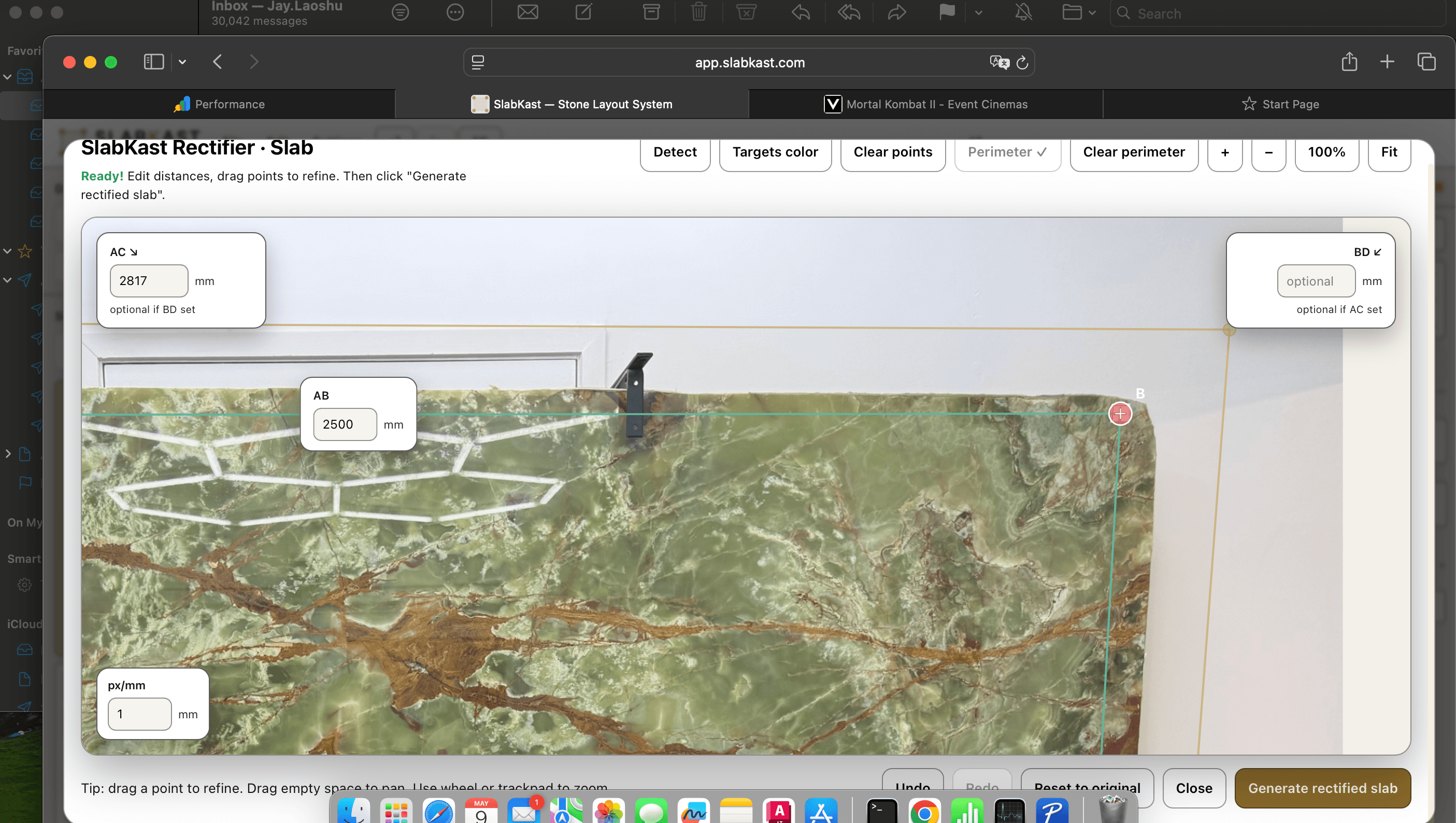
Take a photo of the slab with your smartphone. In SlabKast, mark the four corners and enter the slab dimensions. The software applies perspective-correct rectification, creating a dimensionally accurate digital image where every pixel maps to a real measurement. The slab's actual vein pattern, color gradients, and surface character are preserved in the calibrated image.
Position the horizontal and vertical pieces
Import your DXF templates or draw the countertop and waterfall panel directly in SlabKast. Place both pieces on the calibrated slab image. As you position each piece, you see the actual stone texture under it — the real veins, the real color variation, the real surface character. Arrange the pieces so they occupy adjacent areas of the slab with the miter line between them.
See how veins flow across the miter
This is the critical step. You can see exactly where the miter joint will fall and how the vein pattern transitions from the horizontal piece to the vertical panel. Move pieces to optimize vein flow. Rotate to find the best angle. Try different slab positions to see which produces the strongest visual continuity at the joint. You can test dozens of configurations in minutes, something that would take hours with physical templates on the actual slab.
Get client approval, then cut
Share the waterfall preview with your client. They see the exact vein flow from countertop to panel on their specific slab. They approve the layout or request adjustments. Changes cost nothing at this stage. Once approved, you have a documented record of what the client signed off on, and you cut the slab knowing the waterfall will match. No guesswork. No hope. Just visual confirmation.
Planning the cut for waterfall vein matching
Which part of the slab produces the best waterfall match? The answer depends entirely on vein direction, and the optimal position changes with every slab. This is why digital preview is essential: it lets you explore the entire slab surface to find the position where the miter joint produces the strongest vein continuity.
Veins running perpendicular to the miter line create the most dramatic waterfall effect. When a bold diagonal vein crosses from the countertop surface and continues down the vertical panel at the same angle, the result is visually striking. The eye follows the vein around the corner, creating the illusion of a single continuous piece of stone that bends at 90 degrees.
Veins running parallel to the miter line produce a subtler transition. The vein pattern on the countertop surface ends at the edge, and the vertical panel shows a similar but not identical pattern. Parallel veins can produce beautiful waterfalls, but the match is less obvious to the untrained eye. Some clients prefer this understated look. Others want the dramatic perpendicular flow.
The location of the cut on the slab also affects material yield. A waterfall edge requires a significant amount of stone for the vertical panel, typically 30 to 36 inches of additional material depending on cabinet height. This panel must come from directly adjacent to the countertop piece for vein continuity. Digital preview lets you plan both the countertop and panel positions simultaneously, optimizing for both vein match and material usage.
Kerf loss is another factor that digital planning addresses. The saw blade removes 3 to 5 millimeters of material at every cut. At the miter joint, this kerf shifts the vein position on one piece relative to the other. Experienced fabricators know to account for kerf offset, but seeing the actual vein positions before and after the cut line provides confirmation that the offset is acceptable.
Digital preview does not replace the fabricator's skill. It augments it. The fabricator still makes the judgment call about which vein direction to prioritize and where to position the pieces. The difference is that the judgment is informed by visual evidence rather than mental estimation.
Waterfall and island combinations
The dual waterfall island is the pinnacle of residential stone fabrication. Both sides of the island feature waterfall edges, with the countertop surface flowing down the left panel and down the right panel. Three pieces from the same slab, all with coordinated vein flow. When executed correctly, the result is extraordinary. When executed poorly, the mismatches are visible from across the room.
Without digital layout tools, planning a dual waterfall island requires the fabricator to mentally coordinate three pieces simultaneously: the countertop surface, the left waterfall panel, and the right waterfall panel. All three must come from the same region of the slab. The vein at the left miter must flow continuously from the top, and the vein at the right miter must do the same. The vein direction across the top must also read as natural and coherent.
This is a three-dimensional spatial reasoning problem that most fabricators solve through trial and error with physical templates. The error part is where the $10,000 to $15,000 mistakes happen.
In SlabKast, you position all three pieces on the calibrated slab photo. You see where each miter falls relative to the vein pattern. You can slide the entire group across the slab to find the sweet spot where both waterfalls produce strong vein continuity. You try different rotations. You see the result instantly.
Some slabs simply cannot produce a good dual waterfall. The vein direction may work for the left side but not the right. The slab may not have enough material in the correct orientation to accommodate all three pieces. Digital preview reveals this before you cut, giving you the opportunity to select a different slab or discuss alternatives with the client rather than discovering the problem after a $6,000 cut.
Learn more about waterfall edge layouts and island countertop configurations.
Materials for waterfall edges
Not all stone materials produce equally dramatic waterfall edges. The vein pattern, color contrast, and surface finish all affect how the waterfall reads visually.
Marble
Marble produces the most dramatic waterfall edges. Calacatta, Statuario, and Arabescato feature bold, high-contrast veins that create unmistakable visual flow from surface to panel. The veins are typically large-scale and directional, making the waterfall effect immediately apparent. This also makes mismatches immediately apparent. Marble waterfalls demand precise vein matching because the consequences of failure are highly visible.
Quartzite
Quartzite offers a balance of hardness and beauty that makes it ideal for waterfall edges. Materials like Taj Mahal, Mont Blanc, and Sea Pearl feature flowing veins with a shimmering quality that catches light differently on the horizontal and vertical surfaces. This shimmer can enhance the waterfall effect, but it also requires careful orientation since the stone looks different depending on viewing angle.
Porcelain slabs
Large-format porcelain slabs from Neolith, Dekton, and similar manufacturers offer consistent vein patterns that simplify waterfall matching. The pattern is printed, so vein direction and intensity are uniform across the slab. This consistency makes porcelain forgiving for waterfall edges, though the repeat pattern still requires alignment at the miter joint for a professional result.
Granite
Granite waterfall edges can be challenging because many granites have subtle, dispersed veining rather than the bold linear patterns found in marble. The waterfall effect is less pronounced on materials with speckled or granular patterns. Heavily veined granites like Viscount White or River White produce better waterfalls, but the vein matching requires attention because the patterns are less directional and harder to align visually.
Engineered quartz
Engineered quartz with veined patterns (Calacatta-look, marble-look designs) requires vein matching at the waterfall miter just like natural stone. The manufactured pattern has a specific direction, and misalignment at the joint is visible. Some engineered quartz patterns have a repeat interval that must be identified and accounted for during layout. Digital preview helps find the optimal cut position within the repeat.
Exotic stone
Onyx, backlit panels, exotic quartzites like Patagonia or Blue Bahia, and ultra-premium materials leave zero margin for error on waterfall edges. These slabs cost $5,000 to $15,000 each. A failed waterfall means sourcing a replacement from the same lot, which may no longer be available. Digital preview is not optional on these materials. It is insurance against irreversible, irreplaceable loss.
Common questions about waterfall vein matching
What is waterfall vein matching?
Waterfall vein matching is the process of aligning the vein pattern in a stone slab so that it flows continuously from the horizontal countertop surface, over the mitered edge, and down the vertical panel. The goal is a seamless visual transition at the 90-degree miter joint, making it appear as though the stone bends around the corner rather than being two separate pieces joined together.
Why is the waterfall edge the hardest vein match in fabrication?
The waterfall edge is uniquely difficult because the miter joint is at 90 degrees. The horizontal piece and vertical panel must be cut from adjacent areas of the same slab so the veins continue across the joint. Any rotation, flipping, or kerf loss during cutting affects alignment. Unlike a flat seam where you can slide pieces laterally, a waterfall miter locks the vein position at a fixed angle. You get one chance to match correctly before cutting two expensive pieces.
How much does a failed waterfall edge cost?
A failed waterfall on premium materials like Calacatta marble, Statuario, or exotic quartzite typically costs between $8,000 and $15,000 to redo. That includes the cost of a new slab (often $3,000 to $8,000 alone for premium material), re-fabrication labor, removal and reinstallation, and schedule delays. On a $25,000 kitchen project, a single botched waterfall can erase the entire profit margin.
Can I preview a dual waterfall island digitally?
Yes. In SlabKast, you can position all three pieces — the countertop surface and both vertical side panels — on the slab photo simultaneously. This lets you see how the veins flow from the left panel across the top and down the right panel, ensuring all three pieces produce coordinated vein flow from the same area of the slab. Dual waterfall islands are the most complex vein-matching challenge in residential fabrication, and digital preview makes them plannable.
Which vein direction works best for waterfall edges?
Veins running perpendicular to the miter joint (from back to front of the countertop) typically create the strongest visual flow because they appear to cascade down the vertical panel. Veins running parallel to the miter (left to right across the countertop) create a more subtle, sometimes nearly invisible transition at the waterfall. Digital preview lets you try both orientations and pick the one that produces the best visual result for your specific slab.
Do I need a scanner to do waterfall vein matching in SlabKast?
No. SlabKast works entirely from smartphone photos. Photograph the slab, calibrate it by marking four corners and entering the slab dimensions, then position your horizontal and vertical pieces on the calibrated image. The software applies perspective correction so the vein positions you see digitally correspond to the actual vein positions on the physical slab. No scanner hardware, no dedicated photo station, no specialized lighting required.
Preview your waterfall miter before you make the cut.
Start your 7-day free trial. Photograph the slab, position your waterfall pieces, and see the vein flow across the miter with your own eyes. No credit card required.
Looking for general vein matching? Explore vein matching software →