How to Vein Match Marble Countertops
Marble is defined by its veins. The flowing lines of Calacatta, the subtle grey ribbons of Carrara, the dramatic sweeps of Statuario — these patterns are what make marble the most sought-after countertop material. And they are what make fabrication unforgiving.
A well-matched marble countertop looks like a single, continuous surface. A poorly matched one — where veins abruptly change direction at seams, or clash between the countertop and waterfall edge — looks like a mistake. And at $80–$200 per square foot for premium marble, that mistake is expensive to fix.
What Is Vein Matching?
Vein matching is the process of planning how template pieces are positioned on a slab so that the natural vein patterns flow continuously across seams, edges, and transitions. The goal is visual continuity — making multiple pieces look like one unbroken surface.
This involves three decisions for each piece:
- Position — where on the slab the piece is cut from
- Rotation — the angle of the piece relative to the vein direction
- Flip — whether the piece is mirrored (top face becomes bottom face) to align veins in the opposite direction
Getting all three right for every piece in a multi-piece countertop layout is what separates a premium fabrication job from an average one.
Types of Vein Matching
Bookmatching
The most dramatic form of vein matching. Two sequential slabs from the same block are opened like a book, creating a mirror image across the center line. The result is a symmetrical vein pattern — as if the surface has a reflection running down the middle.
Bookmatching requires two matching slabs, which must be sourced together. It works best for large islands, feature walls, and bathroom vanities where the symmetry becomes the focal point of the space.
Cross-Seam Matching
The most common type of vein matching in countertop fabrication. When a countertop requires a seam — because the run is longer than the slab, or the layout turns a corner — the pieces on either side of the seam are positioned so the veins continue across the joint as smoothly as possible.
Perfect cross-seam matching on natural stone is rarely achievable because veins are irregular and the seam cuts away a small amount of material. The goal is to get as close as possible — matching vein direction, thickness, and spacing so the seam becomes visually subtle.
Waterfall Matching
A waterfall edge is where the countertop surface continues vertically down the side of a cabinet or island. The vein pattern must flow from the horizontal surface down the vertical face without interruption.
This is one of the most challenging vein matching scenarios because the miter joint is at 90 degrees and any misalignment is immediately visible. Success requires precise knowledge of where the slab will be cut and how the vertical piece relates to the horizontal piece in vein direction and position.
Backsplash Matching
Matching the backsplash vein pattern to the countertop so the veins continue from the horizontal surface up the wall. This requires cutting the backsplash pieces from the same slab as the countertop and aligning them during layout to maintain vein continuity.
The Traditional Approach (and Why It Fails)
Traditionally, vein matching is done by eye on the shop floor. The fabricator lays physical templates on the slab, marks the cut lines with a wax pencil, and makes judgment calls about vein alignment based on experience. This works when the fabricator is highly skilled and the layout is simple.
It fails in several predictable ways:
- The client cannot see the result before cutting — they approve a material, not a specific layout
- Complex layouts (waterfall + island + backsplash) have too many variables for reliable mental visualization
- If a different crew member handles layout vs cutting, information is lost
- There is no record of the approved layout for dispute resolution
The cost of getting it wrong on marble: $3,000–$6,000 per remake. On exotic materials, multiply that by two or three. Modern shops are addressing this with scanner-free digital layout tools that make vein matching accessible to any team member.
Digital Vein Matching: The Modern Approach
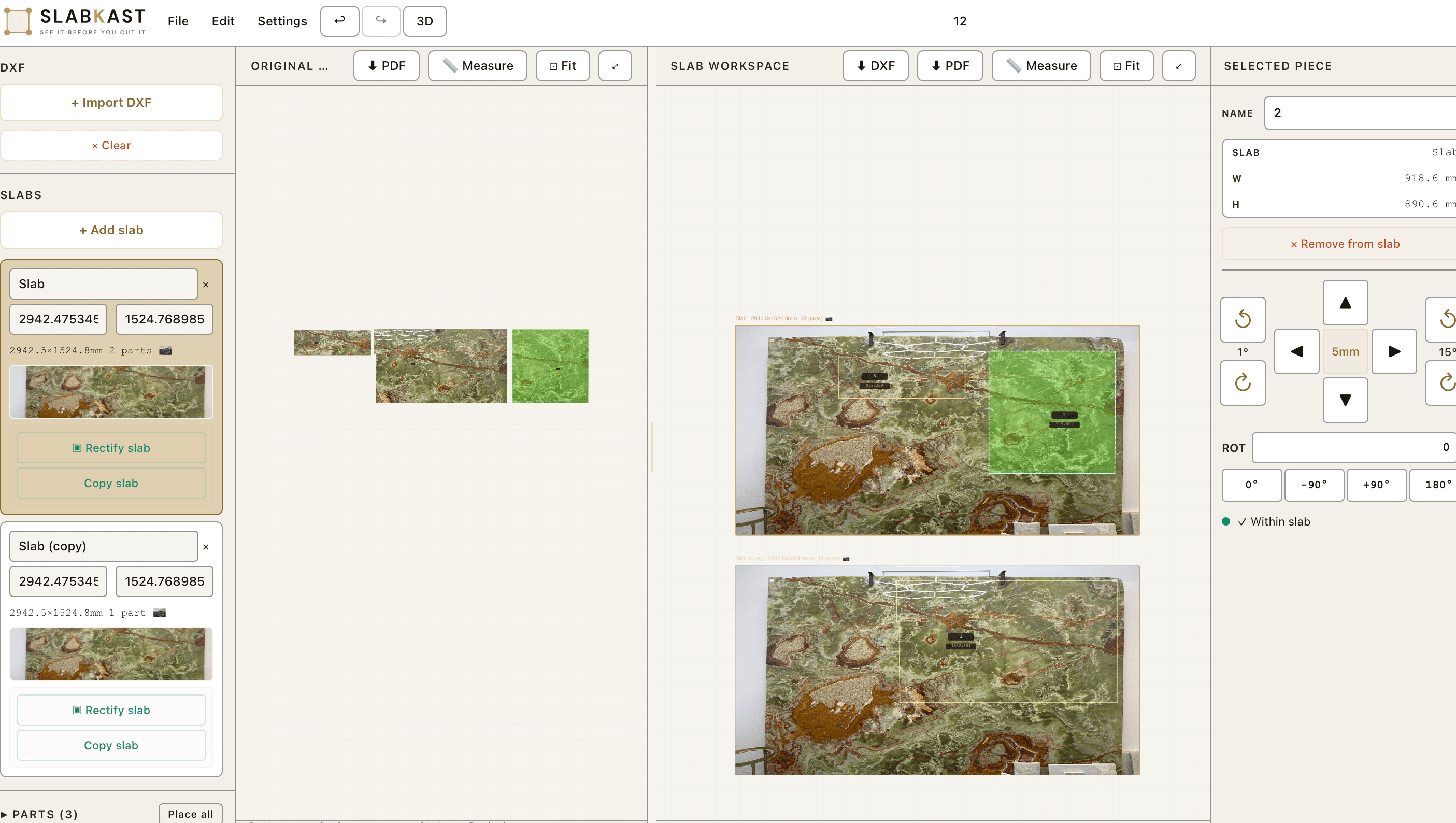
Digital vein matching software changes the process fundamentally. Instead of working by eye on the shop floor, you work on a calibrated photo of the actual slab on a screen.
The workflow:
- Photograph the slab with calibration targets to create a dimensionally accurate digital image
- Import template pieces — the shapes of every piece needed for the countertop
- Drag and position pieces on the slab photo — you see exactly how veins flow through each piece
- Rotate and flip pieces to find the optimal vein alignment across seams and edges
- Send the layout to the client for approval — they see the exact result on the exact slab
- Export DXF once approved — the CNC cuts exactly what was shown
The key advantage: both the fabricator and the client see the exact layout on the exact stone before any cut is made. Mismatches are caught at the planning stage, not the installation stage.
Practical Tips for Better Vein Matching
1. Photograph the entire slab in good lighting
Veins that are visible in person may disappear in a dark or washed-out photo. Use even, diffused lighting. Avoid direct sunlight creating glare. Wet the slab surface slightly if veins are hard to see — water enhances contrast in most marble.
2. Identify the primary vein direction
Most marble has a dominant vein direction. Identify it before placing any pieces. The primary vein direction should flow consistently across the longest run of the countertop.
3. Plan seam locations around vein patterns
Place seams where veins are least prominent or where the vein direction naturally allows for the best match. Avoid placing seams where a thick, prominent vein will be cut — the discontinuity will be obvious.
4. Account for the kerf
The saw blade removes 3–5mm of material at every cut. This means pieces on either side of a seam will not perfectly match — there is always a small gap in the vein pattern. Plan for this by choosing seam locations where a small gap is least noticeable.
5. Show the client before cutting
The single most effective way to prevent vein-matching disputes is showing the client the exact layout on the exact slab before making any cuts. If they approve it, there is no dispute later. This is where digital layout tools pay for themselves.
Frequently Asked Questions
What is vein matching in stone fabrication?
Vein matching is the process of aligning the natural vein patterns in stone across multiple pieces of a countertop so the veins flow continuously across seams, creating the appearance of a single unbroken surface. It requires careful planning of piece placement, rotation, and sometimes flipping during the layout stage.
What is the difference between bookmatching and vein matching?
Bookmatching is a specific type of vein matching where two adjacent slabs (cut sequentially from the same block) are opened like a book so the vein pattern mirrors across the center line. Vein matching is the broader practice of aligning veins across any pieces — it includes bookmatching but also covers matching veins across seams within a single slab, across waterfall edges, and between non-sequential pieces.
Can you vein match engineered stone or quartz?
Engineered quartz has consistent patterns that are less variable than natural stone, so "vein matching" is simpler — mostly a matter of ensuring the pattern direction is consistent across pieces. The veins in engineered quartz are manufactured, so matching is more predictable but still important for a clean result.
How does digital vein matching software work?
Digital vein matching software like SlabKast lets you work on a calibrated photo of the actual slab. You drag template pieces onto the slab image and can see exactly how veins will flow through each piece. You rotate and flip pieces to find the best vein alignment before cutting. This eliminates guesswork and lets you show the client the exact result before committing to the cut.
What materials benefit most from vein matching?
Marble, quartzite, and exotic granites benefit the most because they have strong, directional vein patterns that are highly visible in the finished countertop. Porcelain slabs with marble-look patterns also benefit from vein matching, though the patterns are more consistent. Solid-color materials like plain granite or solid-surface do not require vein matching.
How much does a vein matching mistake cost?
A vein mismatch on a premium marble countertop typically costs $3,000–$6,000 to redo. The cost includes new material (marble slabs are $50–$150+ per square foot), re-fabrication labor, installation labor, and schedule delays. On exotic materials like Calacatta or Blue Bahia, a single mistake can cost $8,000–$15,000.
Match Veins Digitally Before You Cut
SlabKast lets you see exactly how veins flow through every piece — on the real slab. No scanner required.
Start free trial