Vein Matching Software for Marble, Quartzite & Natural Stone
See exactly how veins flow through every piece — before you make the first cut.
Vein matching is the difference between a countertop that looks like a single flowing surface and one that looks like five unrelated pieces of stone glued together. When you get it right, nobody notices. When you get it wrong, it is the only thing anyone sees. The problem is that getting it right by eye — holding pieces in your head, accounting for rotations, flips, and miter angles — is nearly impossible on complex layouts. That is where vein matching software changes the equation.
The $6,000 mismatch
Here is a scenario that plays out in fabrication shops more often than anyone wants to admit. A client selects a Calacatta marble slab for an island with a waterfall edge. Bold grey veins on a white background. Beautiful stone. The fabricator lays out the pieces on the slab, marks the cuts with wax pencil, and proceeds with fabrication.
Everything looks right on the horizontal surface. The veins flow nicely across the island top. But the waterfall panel — the vertical side piece that wraps down from the counter — comes from a different part of the slab. When the miter joint goes together, the veins on the top surface run at 35 degrees. The veins on the side panel run at 60 degrees. At the joint, there is a hard visual break. The stone looks like two separate pieces meeting at a corner instead of one continuous surface wrapping around.
The client walks in, looks at the island, and says: "That is not what I expected. The veins are supposed to flow from the top down the side." She is right. That is what every waterfall edge is supposed to do. The fabricator knew that. But matching veins across a 90-degree miter by looking at a flat slab is genuinely difficult. You have to mentally rotate one piece 90 degrees, flip it, and hold that mental image while comparing it to the adjacent piece. Under shop conditions, with deadlines and distractions, even experienced fabricators miss it.
The cost: a new slab of Calacatta marble runs $3,500 to $4,500. Refabrication labor is another $800 to $1,200. Tear-out and reinstallation adds $500 to $800. Disposal of the rejected pieces. Lost shop time for the day. Total damage: $6,000 or more. And that is assuming you can even find another slab from the same lot. If the lot is sold out, the client may reject a different slab entirely, and now you are looking at a project cancellation on top of everything else.
Why eye-based matching fails
Your eye is good at comparing two things side by side. It is terrible at rotating one of those things 90 degrees in your head and then comparing. That is exactly what vein matching requires. The piece on the countertop surface is horizontal. The waterfall piece is vertical. The backsplash piece is vertical but in a different plane. Corner pieces rotate 90 degrees. Every rotation changes the apparent direction of every vein in the stone.
On a simple two-piece countertop with one seam, experienced fabricators can match veins by eye with reasonable confidence. The pieces sit next to each other on the slab. You can see the vein direction. It works. But add a waterfall edge, and now you need a mental 90-degree rotation. Add a mitered corner, and you need to account for the miter angle. Add a backsplash that runs behind a faucet, and you need to verify that the vein pattern on the backsplash continues the pattern from the countertop surface even though the two pieces are in perpendicular planes.
A full kitchen with an island, two waterfall edges, an L-shaped perimeter counter, and a full-height backsplash has eight or more pieces that all need to relate to each other visually. Each piece can be rotated, flipped, or mirrored. The number of possible orientations grows exponentially. No fabricator, no matter how experienced, can hold all of those relationships in their head simultaneously.
That is not a skill problem. It is a cognitive limitation. Your brain was not designed to mentally rotate complex patterns across eight pieces at once. Software was. When you see all the pieces placed on the slab at once, with the correct rotations and orientations applied, vein matching goes from a risky guessing game to a straightforward visual check. You look at the screen and either the veins flow or they do not. If they do not, you drag a piece and look again. The risk drops to near zero.
Digital vein matching on real photos
Most scanner systems reduce the slab to a geometry outline with a low-resolution texture mapped on top. You can see the general color and maybe the major vein lines, but the subtlety is gone. The secondary veins, the color gradients, the spots where the density changes — all of that gets lost in the scan processing.
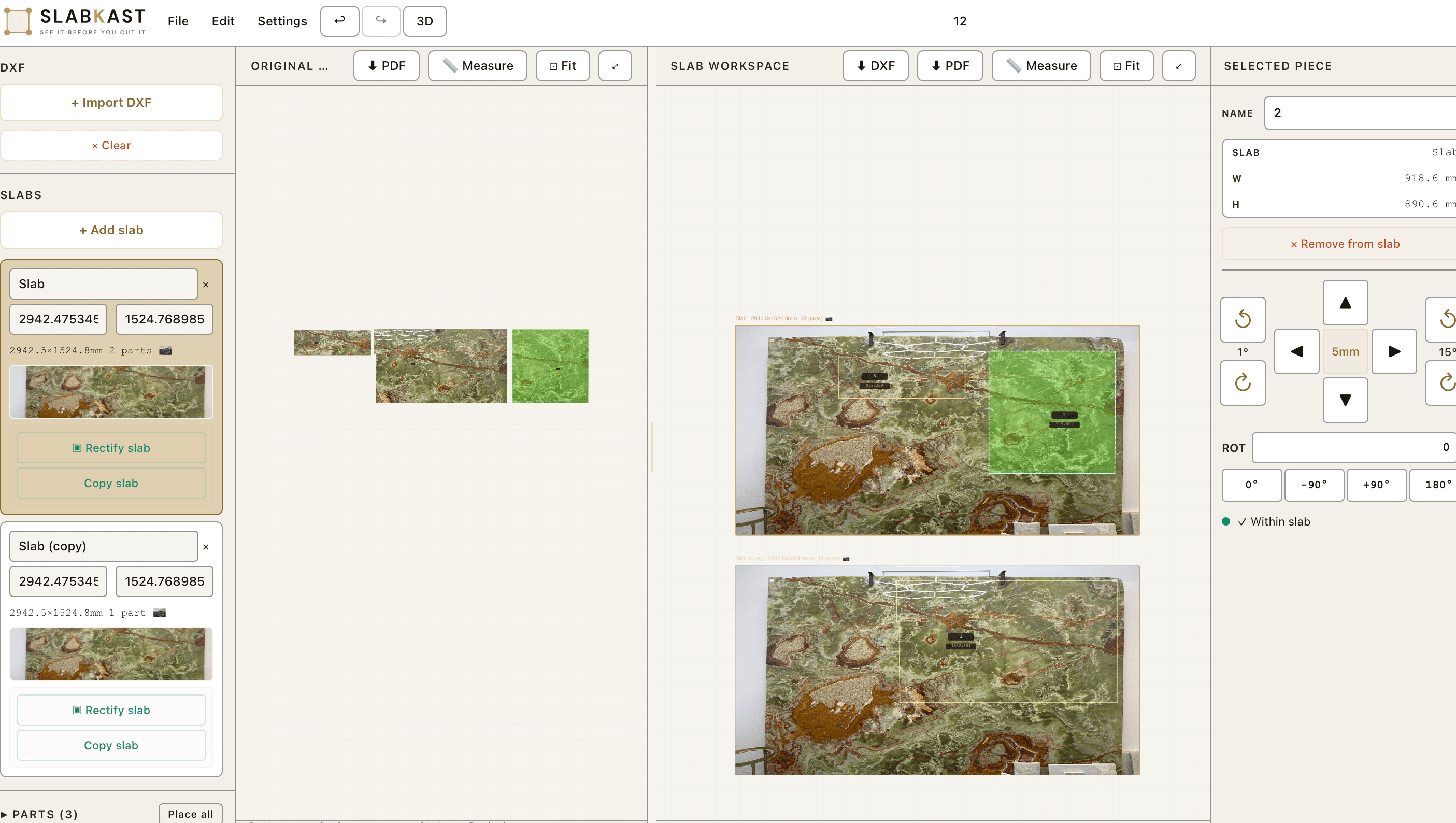
SlabKast works on the actual photograph. A high-resolution phone photo captures every detail of the stone surface at a resolution that scanners cannot match. When you place template pieces on the slab image, you see the real veins underneath each piece. You can zoom in to the seam line and check whether a thin secondary vein continues across the joint. That level of detail is what separates a good vein match from a great one.
The workflow is direct: photograph the slab, calibrate in SlabKast, import your template pieces, and start positioning. As you drag each piece, the slab image shows through the piece outline. You see the veins. You rotate a piece and the vein direction changes accordingly. You flip a piece for a bookmatch orientation and the mirror pattern appears instantly.
There is no mental rotation required. The software handles the transformation and shows you the result. Your job is to look at the screen and decide: does this flow? If not, adjust. If it does, move to the next piece. A full vein-matched layout for a complex kitchen takes 15 to 20 minutes instead of the hour or more it takes to match by eye on the physical slab.
Waterfall edge matching
Waterfall edges are the highest-stakes vein matching challenge in residential fabrication. The client has chosen a dramatic veined stone specifically because they want that continuous flow from the countertop surface down the side of the island. If the veins do not wrap around the miter corner, the entire design intent is lost. And this is the most visible surface in most kitchens — the face of the island, often seen from the living room or dining area.
The technical challenge is the 90-degree miter joint. The top piece and the side piece meet at a 45-degree angle cut on each edge. For the vein to appear continuous across this joint, the two pieces need to come from adjacent areas of the slab, and the side piece needs to be oriented so that the vein pattern at the miter edge matches the vein pattern at the edge of the top piece. On the flat slab, these two pieces are side by side. After cutting and assembly, one piece rotates 90 degrees and drops vertically.
In the digital layout, you position the top piece and the waterfall panel next to each other on the slab image. You can see exactly where the veins align at the shared edge. If the veins do not line up, you slide one piece until they do. You can preview the folded-over result to verify the 90-degree wrap. All of this happens before any stone is cut.
For double waterfall islands — where both ends of the island have vertical panels — the challenge doubles. You need vein continuity at two miter joints, which means three pieces (left waterfall, top surface, right waterfall) all need to come from the right areas of the slab and all need to be oriented correctly. Doing this by eye on a physical slab is a coin flip at best. Doing it digitally, you see all three pieces on the slab at once, check both joints, and know the result before you commit to the cut. That is the value of vein matching software on the jobs that matter most.
Bookmatching without the guesswork
Bookmatching uses two adjacent slabs from the same block, opened like a book, so the vein pattern on one slab mirrors the pattern on the other. When installed side by side — on a large island, a feature wall, or a fireplace surround — the mirrored veins create a dramatic symmetrical pattern that no single slab can produce.
The challenge is that "mirror pattern" sounds simple but the execution is not. The two slabs are never perfectly identical. There are thickness variations, edge differences, and slight shifts in vein position from the sawing process. The bookmatched seam — the centerline where the two slabs meet — needs precise alignment for the mirror effect to work. If the pieces are positioned even half an inch off at the seam, the symmetry breaks and the whole point of bookmatching is lost.
With vein matching software, you photograph both slabs, load them into the same project, and position pieces across the pair. One slab image is flipped to show the mirror orientation. You see the bookmatch pattern on screen before any fabrication begins. You can adjust piece positions to maximize the symmetry at the center seam. You can verify that secondary veins align, not just the primary pattern.
For materials like onyx and exotic quartzite, where a bookmatched pair of slabs can cost $15,000 or more, the digital preview is not optional. You cannot afford to cut a $7,500 slab and discover the mirror alignment is off. The slab layout needs to be verified digitally first. Every time.
Materials that demand vein matching
Not every stone requires the same level of vein matching attention. Uniform materials like solid-color engineered quartz are forgiving. But the materials clients are willing to pay premium prices for are almost always the ones with the most challenging vein patterns. These are the stones where vein matching software pays for itself on a single project.
Marble
Calacatta, Statuario, Arabescato. Bold veins on light backgrounds make every mismatch visible from across the room. Marble is the material that built the demand for vein matching software.
Quartzite
Taj Mahal, Cristallo, Patagonia. Quartzite combines marble-like veining with granite-like durability. Clients pay $80 to $120 per square foot and expect flawless vein continuity.
Exotic Granite
Blue Bahia, Van Gogh, Labradorite. Not your builder-grade granite. These stones have dramatic directional patterns that require careful orientation on every piece.
Onyx
Translucent, highly veined, and extraordinarily expensive. A single slab of backlit onyx can cost $8,000 or more. There is no margin for vein matching errors.
Questions about vein matching in production
What is vein matching in stone fabrication?
Vein matching is the process of aligning the natural vein patterns in stone across multiple pieces so the installed countertop looks continuous. When a kitchen requires seams, the vein pattern at each joint needs to flow naturally from one piece to the next. For waterfall edges, the vein must continue from the horizontal surface down the vertical face. Getting this right determines whether the finished countertop looks like one continuous piece of stone or a collection of mismatched slabs.
Can vein matching software work with phone photos instead of scanner images?
Yes. SlabKast uses calibrated phone photos of actual slabs. You photograph the slab with calibration targets, and the software corrects the perspective to create a dimensionally accurate digital image. You then work directly on that image to match veins across pieces. The advantage over scanner systems is that you see the actual color and vein detail of the stone, not a processed outline.
How does digital vein matching help with waterfall edges?
Waterfall edges require the vein pattern to flow from the horizontal countertop surface down the vertical side panel at a 90-degree miter joint. In the digital layout, you position the top piece and the side piece adjacent to each other on the slab, rotate and flip as needed, and verify that the vein pattern will continue across the miter. You see this before cutting, so you can adjust until the match is right. Without digital preview, you are relying on experience and hoping the veins line up after the miter cut.
What materials benefit most from vein matching software?
Any stone with visible veining benefits. Marble — especially Calacatta and Statuario — is the most common use case because the veins are bold and any mismatch is immediately obvious. Quartzite varieties like Taj Mahal and Cristallo also demand vein matching. Exotic granites with strong linear patterns, and translucent stones like onyx where light passes through and highlights every directional change, are other materials where vein matching makes or breaks the result.
Does vein matching add time to the layout process?
With digital tools, vein matching takes minutes rather than the hours it takes to match by eye on a physical slab. You drag pieces, rotate them, and see the vein alignment instantly. Compare that to marking a slab with wax, studying the veins, erasing and re-marking, then hoping your visual assessment holds after the cut. Digital vein matching is faster and more reliable than the manual alternative.
Can I show the client the vein match before I cut?
Yes. Once you finalize the vein-matched layout in SlabKast, you send the client an approval link. They see every piece positioned on the actual slab photograph with veins visible through each piece. They can verify that the veins flow the way they expect across seams, around waterfall edges, and between adjacent surfaces. This visual approval eliminates the most common source of vein-related disputes: the client imagined something different from what the fabricator produced.
Preview the vein flow before you commit to the cut.
Upload a slab photo and see how your pieces sit on the stone. Check the veins at every seam, every waterfall joint, every miter. Know the result before you start the saw. Free trial, no credit card.
Need full layout and CNC export too? See how slab layout software handles the complete workflow →